
Welcome to our website
The aim of this website is to give general information on the pathology and signs of malaria as well as some details in treatments, prevention and both past and current research.
Human malaria is a life-threatening disease caused by four species of parasites: P.falciparum, P.vivax, P ovale and P. malariae. Malaria probably originated from animal malarias in central Africa, but was spread around the world due to human migration. It can be transmitted to people by the bite of female anopheline mosquitoes or in contaminated blood transfusions. Each year, there are probably five hundred million people affected, and over one million of them die.
The parasites undergo a temperature dependent life cycle in the gut of mosquitoes. Therefore the geographical range of the disease is highly depends on the presence of appropriate mosquitoes and temperature. According to World Health Organization, the disease mainly occurs throughout the tropical and subtropical regions except for some areas above 2000m.
Children are especially vulnerable to malaria and there is a positive correlation between children mortality and regions of substantial malaria incidences. It is a very common disease and affects about 250 million people annually. Of these 250million people a little over 1 million die, of which are mostly children younger than 5 years old.
Malaria is an old disease and date back even to the end of the World War II. In 1955 with the development of nuvo drug treatments such as Chloroquine and dichlorodiphenyltrichloroethane (DDT) the World Health Organisation began a campaign to annihilate malaria. This reduced rates in many areas of the world, but the malaria parasite prevailed in Sub Sahara Africa. In the 1950s to 70s due to availability of Chloroquine health of young children was boosted. Unfortunate the overuses of chloroquine lead to the evolution of Chloroquine resistant species in the plasmodium genus.
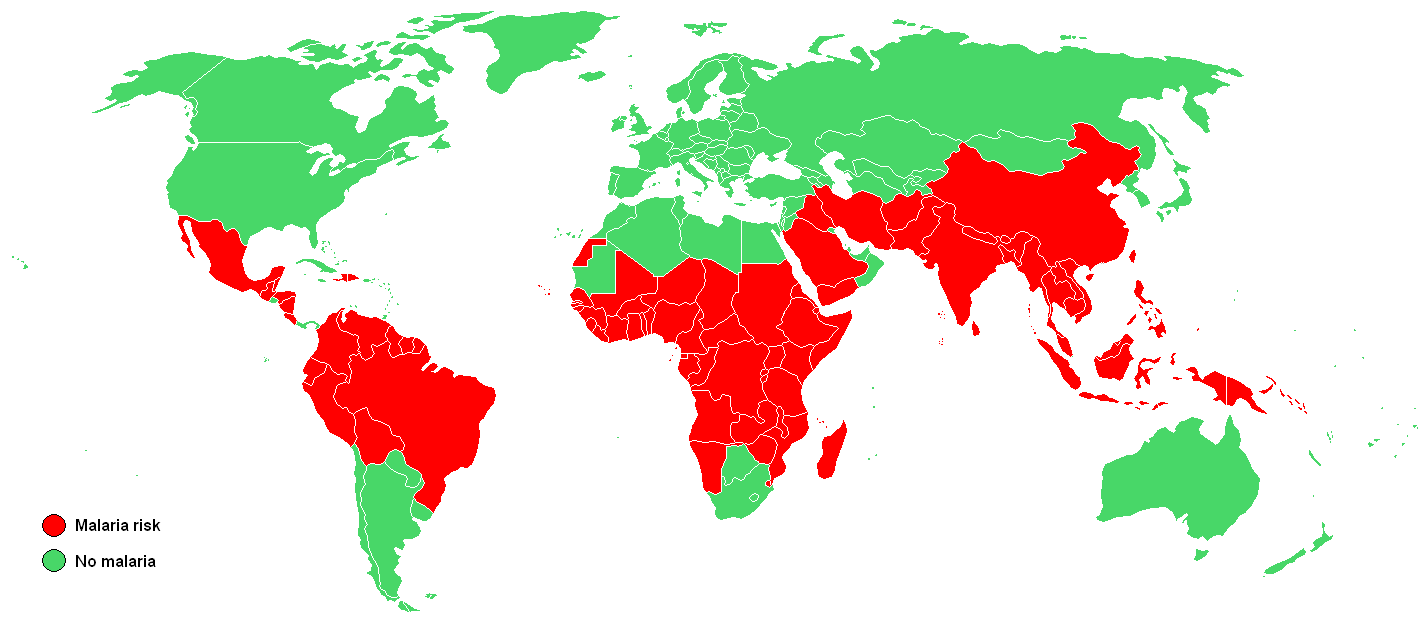
This is a very simplified map showing countries at risk of malaria as on 2003. As the map shows the disease is restricted to tropical regions. It is also important to know this map of malaria distribution would has changed at present.
|
Image courtesy of https://commons.wikimedia.org/wiki/File:Malaria_map.PNG Image is in public domain and thus free from copyright restrictions |
